
Kasparov – Deep Blue Match 1997

Garry Kasparov’s rematch with IBM’s Deep Blue took place in New York from 3 to 11 May 1997. Six games at classical time controls ended 3½–2½ in the computer’s favour: two wins for Deep Blue, one for Kasparov and three draws. It was the first time a computer had beaten a reigning world chess champion in a match under standard tournament conditions. The encounter was an exhibition contest rather than a match for Kasparov’s world title, but its influence reached far beyond the chess audience.
Kasparov had won their first match in Philadelphia in 1996 by 4–2, despite losing the opening game. The rematch brought a strengthened machine and a different challenge. IBM describes Deep Blue as evaluating about 200 million positions per second, using specialised chess hardware alongside parallel processing. That capacity was formidable, but the chess question was more specific than whether a machine could calculate quickly: could Kasparov guide it into positions where long-term plans mattered more than immediate tactics?
The first game seemed to support his approach. A flexible knight-and-fianchetto opening avoided a direct theoretical confrontation, and Kasparov won with a dangerous passed pawn. Game 2 changed the atmosphere. In a closed Ruy Lopez, Deep Blue restricted Black’s counterplay rather than grabbing every available pawn. Its bishop manoeuvre impressed and unsettled Kasparov, who subsequently questioned whether the machine had received human assistance. That was his allegation, not an established explanation for the moves. The actual game remains valuable because it shows the strength of restricting an opponent’s activity.
There was an additional sting: Kasparov resigned game 2 in a position where later analysis found drawing resources. The distinction matters. Deep Blue had built a strong position, but the recorded result does not mean that every move of the conversion was faultless. ChessBase’s later analysis revisits the famous positional decision, while the match history records the missed perpetual-check possibility at the end. For players, the lesson is to look for active defensive resources even when the preceding course of the game has been discouraging.
Three draws followed. Kasparov experimented with the unusual first move 1.d3 in game 3 and reached positions where plans and pawn structures were central. Game 4 produced an active rook struggle, while game 5 gave him another chance to regain the lead. Deep Blue’s defence survived both, and the match reached the final game at 2½–2½. Kasparov then chose a risky Caro–Kann line, allowing a familiar knight sacrifice on e6. The computer accepted it and won in only nineteen moves, a strikingly short finish to an encounter that had contained several lengthy strategic battles.
Replay all six games from either side, treating them as chess positions rather than a verdict on human creativity. The collection combines flexible opening choices, positional restriction, passed-pawn races, rook activity and the danger of trusting an opponent to reject a sacrifice. Modern Stockfish analysis provides a separate way to examine the decisions; it does not reproduce Deep Blue’s original search or explain exactly what the 1997 machine was thinking.
Match results
| Player | Game 1 | Game 2 | Game 3 | Game 4 | Game 5 | Game 6 | Points |
|---|---|---|---|---|---|---|---|
| Deep Blue | 0 | 1 | ½ | ½ | ½ | 1 | 3½ |
| Garry Kasparov | 1 | 0 | ½ | ½ | ½ | 0 | 2½ |
Each game column shows the score earned by that player. 1 = win, ½ = draw, 0 = loss. Points are out of 6.
Completed 0 / 6
Game 1: Kasparov wins the opening game
Kasparov began with a flexible Réti-style setup and developed both bishops by fianchetto before expanding in the centre. Deep Blue’s active pawn play produced complications, but White emerged with a dangerous passed g-pawn. Kasparov advanced it to the seventh rank and won in 45 moves. The game gave him the first lead of the rematch and a practical example of steering a computer away from a direct opening-theory battle.
| Game | Event | Year | Moves | Played | Current move | Score | Correct | Accuracy | Action |
|---|---|---|---|---|---|---|---|---|---|
| Garry Kasparov – Deep Blue (Computer) 1-0 | IBM Man-Machine | 1997 | 45 | No | — | — | — | — | Start |
Game 2: Positional restriction and a premature resignation
Deep Blue used the Ruy Lopez to restrict Kasparov’s counterplay, with 37.Be4 becoming the celebrated positional decision. Kasparov later alleged human interference, but the allegation is not evidence that a person chose the move. He resigned after 45.Ra6, although subsequent analysis found a route to perpetual check in the final position. Study the machine’s restriction strategy and the defender’s missed resources as separate parts of the same game.
| Game | Event | Year | Moves | Played | Current move | Score | Correct | Accuracy | Action |
|---|---|---|---|---|---|---|---|---|---|
| Deep Blue (Computer) – Garry Kasparov 1-0 | IBM Man-Machine | 1997 | 45 | No | — | — | — | — | Start |
Game 3: An unusual first move
Kasparov’s unusual 1.d3 soon transposed into an English Opening structure. Queenside expansion and a kingside pawn advance created an imbalanced game, while Deep Blue countered against White’s loose pawns and pieces. After the queens came off, Kasparov’s active king and passed pawn did not produce a breakthrough. The draw kept the match level and showed that avoiding the main opening lines did not guarantee a winning position.
| Game | Event | Year | Moves | Played | Current move | Score | Correct | Accuracy | Action |
|---|---|---|---|---|---|---|---|---|---|
| Garry Kasparov – Deep Blue (Computer) 1/2-1/2 | IBM Man-Machine | 1997 | 48 | No | — | — | — | — | Start |
Game 4: Active rooks keep the balance
Kasparov began with 1...c6 but followed with ...d6 and ...Nf6, reaching a Pirc-like structure instead of a normal Caro–Kann. Both sides castled long, and the game developed into a sharp contest of pawn breaks and rook activity. Black obtained promising counterplay but could not convert it, while White’s advanced e-pawn remained an important defensive resource. The draw left the score at 2–2.
| Game | Event | Year | Moves | Played | Current move | Score | Correct | Accuracy | Action |
|---|---|---|---|---|---|---|---|---|---|
| Deep Blue (Computer) – Garry Kasparov 1/2-1/2 | IBM Man-Machine | 1997 | 56 | No | — | — | — | — | Start |
Game 5: A passed pawn is not enough
Kasparov returned to a flexible knight-and-fianchetto opening and generated real chances in the ending. Deep Blue’s active rook and knight kept creating threats even as White’s kingside pawns advanced. Kasparov could not find the winning continuation, and the game was drawn with his g-pawn one step from promotion. The counterplay behind that apparently triumphant pawn is the central lesson of the fifth game.
| Game | Event | Year | Moves | Played | Current move | Score | Correct | Accuracy | Action |
|---|---|---|---|---|---|---|---|---|---|
| Garry Kasparov – Deep Blue (Computer) 1/2-1/2 | IBM Man-Machine | 1997 | 49 | No | — | — | — | — | Start |
Game 6: The nineteen-move decider
The final game began with a Caro–Kann, but Kasparov’s early ...h6 allowed the thematic 8.Nxe6 sacrifice. Deep Blue accepted the challenge, leaving Black’s king in the centre and exploiting the open lines with rapid development. After 19.c4 Kasparov resigned, giving the computer a 3½–2½ match victory. The finish shows why a familiar attacking sacrifice cannot safely be dismissed on the assumption that an engine will avoid a long-term investment.
| Game | Event | Year | Moves | Played | Current move | Score | Correct | Accuracy | Action |
|---|---|---|---|---|---|---|---|---|---|
| Deep Blue (Computer) – Garry Kasparov 1-0 | IBM Man-Machine | 1997 | 19 | No | — | — | — | — | Start |
Sources and image credits
- Results source
- 1997 match results and game records (Wikipedia)
- IBM’s Deep Blue history
- The famous game-2 decision (ChessBase)
- Game 1: Kasparov wins the opening game — game record (Wikipedia)
- Game 2: Positional restriction and a premature resignation — game record (Wikipedia)
- Game 3: An unusual first move — game record (Wikipedia)
- Game 4: Active rooks keep the balance — game record (Wikipedia)
- Game 5: A passed pawn is not enough — game record (Wikipedia)
- Game 6: The nineteen-move decider — game record (Wikipedia)
- An IBM Deep Blue cabinet on display at the Computer History Museum. — photograph (Wikimedia Commons) · CC BY 2.0 image license
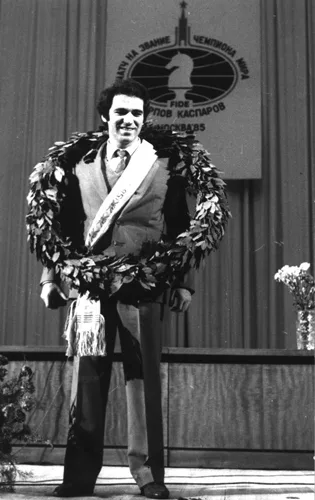
- Garry Kasparov celebrating his 1985 World Championship victory. — photograph (Wikimedia Commons) · CC BY-SA 3.0 image license
- Full image credits and attribution

