
Carlsen – Karjakin World Championship Match 2016
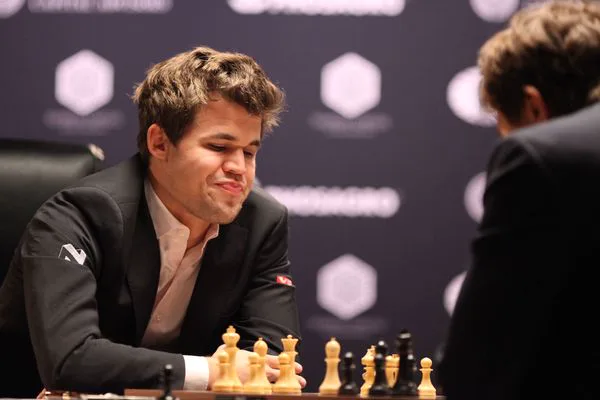

Magnus Carlsen defended his world title against Sergey Karjakin at the Fulton Market Building in New York from 11 to 30 November 2016. Karjakin had earned the challenge by winning the Candidates Tournament in Moscow. The scheduled twelve classical games ended 6–6, with one win each and ten draws. Carlsen then won the four-game rapid playoff 3–1, retaining the championship on his 26th birthday. Study all sixteen games, including the defensive saves and the queen sacrifice that ended the match.
The opening sequence was a contest of persistence against resistance. Carlsen tried the Trompowsky in the first game, then searched for opportunities in the Ruy Lopez and in quieter queen’s-pawn structures. Games 3 and 4 put Karjakin under sustained pressure for hours. Neither became a win: active rooks, careful piece coordination and a blockade helped the challenger survive. Those saves explain why an apparently draw-heavy match remained gripping for players interested in technique. Reaching a favourable ending was only the beginning; finishing it was another problem altogether.
Karjakin finally broke the deadlock with Black in game 8. Carlsen continued pushing a position that had offered little objective advantage, and the challenger’s passed a-pawn became the decisive threat. For the first time in the match the champion was behind. Carlsen’s frustration was visible when he left the post-game press conference before it began. He later described having “all sorts of negative thoughts” after that loss, a revealing account of how difficult it was to regain his usual confidence under match pressure.
The next two games tested that recovery. Karjakin pressed in game 9, but Carlsen held an uncomfortable queen-and-bishop ending. In game 10 the roles reversed: Karjakin missed an early tactical route to easier play, and Carlsen kept working in a long ending until the defence gave way. After 75 moves the score was level again. Two further draws brought the match to the rapid playoff, with Carlsen later explaining that he had deliberately aimed for the tiebreak after game 11 rather than risk everything in the final classical game.
Karjakin’s resistance carried into the rapid games. He survived a difficult second game with bishops against a rook, using a stalemate resource after another long defence. Carlsen then won game 3 with Black, so Karjakin needed victory in the last game. His Sicilian created a fight, but Carlsen’s secure position and active rooks gave him the stronger attack. The final 50.Qh6+ offered the queen to either pawn or king: both captures allowed mate on the next move. It was a spectacular end to a championship built largely on patient pressure.
The players’ closing comments are useful context for the games. Carlsen said he had been “in a dark place” during the match but had rediscovered joy in playing by the end. Karjakin admitted that switching from twelve classical games to rapid had not worked for him that day. Replay their decisions from either side: this collection offers stubborn defence, missed conversions, a comeback from behind and a final tactical finish, rather than a sequence of effortless wins by the favourite.
Match background: Classical match and results · Rapid playoff and player comments
Match results
| Player | Game 1 | Game 2 | Game 3 | Game 4 | Game 5 | Game 6 | Game 7 | Game 8 | Game 9 | Game 10 | Game 11 | Game 12 | Game 13 | Game 14 | Game 15 | Game 16 | Points |
|---|---|---|---|---|---|---|---|---|---|---|---|---|---|---|---|---|---|
| Magnus Carlsen | ½ | ½ | ½ | ½ | ½ | ½ | ½ | 0 | ½ | 1 | ½ | ½ | ½ | ½ | 1 | 1 | 9 |
| Sergey Karjakin | ½ | ½ | ½ | ½ | ½ | ½ | ½ | 1 | ½ | 0 | ½ | ½ | ½ | ½ | 0 | 0 | 7 |
Each game column shows the score earned by that player. 1 = win, ½ = draw, 0 = loss. Points are out of 16.
Completed 0 / 16
Game 1: A Trompowsky surprise
Carlsen surprised the audience with the Trompowsky, exchanging bishop for knight and accepting an early queen trade. Karjakin’s doubled pawns did not become a serious weakness because his pieces remained active and the position simplified. Carlsen later joked that the volume of questions about the opening might have persuaded him to choose something else. Source
| Game | Event | Year | Moves | Played | Current move | Score | Correct | Accuracy | Action |
|---|---|---|---|---|---|---|---|---|---|
| Magnus Carlsen – Sergey Karjakin 1/2-1/2 | Carlsen - Karjakin World Championship Match | 2016 | 42 | No | — | — | — | — | Start |
Game 2: Solid play in the Ruy Lopez
Karjakin opened with the Ruy Lopez but chose a restrained d3 setup rather than the sharpest main lines. Carlsen’s solid central structure and comfortable development left White without a convincing regrouping plan. After the early piece exchanges the game was drawn, and Carlsen pointed out that a long match could not produce fireworks in every game. Source
| Game | Event | Year | Moves | Played | Current move | Score | Correct | Accuracy | Action |
|---|---|---|---|---|---|---|---|---|---|
| Sergey Karjakin – Magnus Carlsen 1/2-1/2 | Carlsen - Karjakin World Championship Match | 2016 | 33 | No | — | — | — | — | Start |
Game 3: Karjakin’s first marathon save
Carlsen’s Berlin sideline led to the first major test of Karjakin’s defence. The champion won a pawn and pressed deep into a rook-and-knight ending, but Karjakin’s active rook and passed h-pawn supplied vital counterplay. After nearly seven hours, Carlsen could not turn his chances into a win. His post-game disappointment gives this draw a very different character from the quiet opening encounters. Source
| Game | Event | Year | Moves | Played | Current move | Score | Correct | Accuracy | Action |
|---|---|---|---|---|---|---|---|---|---|
| Magnus Carlsen – Sergey Karjakin 1/2-1/2 | Carlsen - Karjakin World Championship Match | 2016 | 78 | No | — | — | — | — | Start |
Game 4: A blockade holds after 94 moves
Karjakin’s 18.Bxh6 created complications in a closed Ruy Lopez, but Carlsen emerged with the better chances. The challenger traded queens and spent the rest of the game defending an inferior ending. Carlsen’s 45...f4 made a blockade easier to establish, and Karjakin held after 94 moves. Compare the defender’s piece placement with the attacker’s pawn breaks before committing to an irreversible advance. Source
| Game | Event | Year | Moves | Played | Current move | Score | Correct | Accuracy | Action |
|---|---|---|---|---|---|---|---|---|---|
| Sergey Karjakin – Magnus Carlsen 1/2-1/2 | Carlsen - Karjakin World Championship Match | 2016 | 94 | No | — | — | — | — | Start |
Game 5: The champion faces counterplay
A quiet Italian Game did not give Carlsen the sort of enduring pressure he wanted. Karjakin created kingside counterplay and briefly made the champion’s position uncomfortable. Carlsen contained the threats and the players reached a drawn rook ending. It was the first real reminder that pressing with White could also create defensive work for the favourite. Source
| Game | Event | Year | Moves | Played | Current move | Score | Correct | Accuracy | Action |
|---|---|---|---|---|---|---|---|---|---|
| Magnus Carlsen – Sergey Karjakin 1/2-1/2 | Carlsen - Karjakin World Championship Match | 2016 | 51 | No | — | — | — | — | Start |
Game 6: Activity compensates for a pawn
Carlsen’s pawn sacrifice in a Marshall-style Ruy Lopez demonstrated how active pieces can compensate for material. Karjakin had an extra pawn for part of the game, but Black’s development and central pressure prevented him from consolidating it. The position simplified quickly into a draw. Study the exchanges that let the defender recover his investment rather than treating every pawn win as a lasting advantage. Source
| Game | Event | Year | Moves | Played | Current move | Score | Correct | Accuracy | Action |
|---|---|---|---|---|---|---|---|---|---|
| Sergey Karjakin – Magnus Carlsen 1/2-1/2 | Carlsen - Karjakin World Championship Match | 2016 | 32 | No | — | — | — | — | Start |
Game 7: Opposite-coloured bishops hold
Karjakin switched to a queen’s-pawn opening after failing to make progress with his earlier king’s-pawn games. A forcing sequence of exchanges left him a pawn ahead in an opposite-coloured bishop ending. Carlsen’s active pieces and the reduced material meant the extra pawn could not be converted. The seventh draw kept the match level, immediately before its first decisive result. Source
| Game | Event | Year | Moves | Played | Current move | Score | Correct | Accuracy | Action |
|---|---|---|---|---|---|---|---|---|---|
| Sergey Karjakin – Magnus Carlsen 1/2-1/2 | Carlsen - Karjakin World Championship Match | 2016 | 33 | No | — | — | — | — | Start |
Game 8: Karjakin takes the lead
Carlsen chose a restrained queen’s-pawn setup but continued seeking complications after the position had become balanced. Karjakin weathered the pressure, then used queen and knight activity to support a dangerous passed a-pawn. White’s attempts to manufacture counterplay failed and Karjakin won with Black. Carlsen’s departure from the press conference afterwards showed how deeply the first loss had affected him. Source
| Game | Event | Year | Moves | Played | Current move | Score | Correct | Accuracy | Action |
|---|---|---|---|---|---|---|---|---|---|
| Magnus Carlsen – Sergey Karjakin 0-1 | Carlsen - Karjakin World Championship Match | 2016 | 52 | No | — | — | — | — | Start |
Game 9: Carlsen survives the follow-up
Karjakin used the Ruy Lopez to press the champion immediately after taking the lead. White’s active heavy pieces and attacking chances forced Carlsen to defend carefully before the game reached a queen-and-bishop ending. The champion held the draw despite continued pressure. It was an essential result for keeping the match within reach rather than an easy recovery from game 8. Source
| Game | Event | Year | Moves | Played | Current move | Score | Correct | Accuracy | Action |
|---|---|---|---|---|---|---|---|---|---|
| Sergey Karjakin – Magnus Carlsen 1/2-1/2 | Carlsen - Karjakin World Championship Match | 2016 | 74 | No | — | — | — | — | Start |
Game 10: The champion levels the score
Carlsen returned to the Ruy Lopez and kept the game going after Karjakin missed an early tactical simplification. White’s extra space and active king became increasingly important in the long ending. A queenside breakthrough finally removed the defender’s counterplay, and Carlsen won after 75 moves. The victory restored the score to 5–5 and rewarded persistence after several earlier missed conversions. Source
| Game | Event | Year | Moves | Played | Current move | Score | Correct | Accuracy | Action |
|---|---|---|---|---|---|---|---|---|---|
| Magnus Carlsen – Sergey Karjakin 1-0 | Carlsen - Karjakin World Championship Match | 2016 | 75 | No | — | — | — | — | Start |
Game 11: Perpetual check and playoff plans
Karjakin again used a quiet Ruy Lopez, but Carlsen answered with a pawn sacrifice and active central play. Black’s advanced e-pawn and queen counterplay made it difficult for White to play for a safe win. The game ended by perpetual check, leaving the score level. Carlsen later said that after this draw his strategy was to take the match to the rapid playoff. Source
| Game | Event | Year | Moves | Played | Current move | Score | Correct | Accuracy | Action |
|---|---|---|---|---|---|---|---|---|---|
| Sergey Karjakin – Magnus Carlsen 1/2-1/2 | Carlsen - Karjakin World Championship Match | 2016 | 34 | No | — | — | — | — | Start |
Game 12: A short draw sends it to rapid
Carlsen’s final classical game was a short draw in a Berlin ending. The players exchanged enough material to remove serious winning chances, finishing after 30 moves. The result completed a 6–6 classical match and sent the title to a four-game rapid playoff. Its brevity makes more sense alongside Carlsen’s later admission that he had chosen to aim for the tiebreak. Source
| Game | Event | Year | Moves | Played | Current move | Score | Correct | Accuracy | Action |
|---|---|---|---|---|---|---|---|---|---|
| Magnus Carlsen – Sergey Karjakin 1/2-1/2 | Carlsen - Karjakin World Championship Match | 2016 | 30 | No | — | — | — | — | Start |
Game 13: Rapid 1: a balanced start
The first rapid game was another Ruy Lopez, with Karjakin unable to turn the white pieces into lasting pressure. Carlsen’s active counterplay encouraged exchanges and the game reached a balanced ending. The draw preserved the tension of the classical match in the shorter time control. Neither player had yet found a way to break the other’s resistance. Source
| Game | Event | Year | Moves | Played | Current move | Score | Correct | Accuracy | Action |
|---|---|---|---|---|---|---|---|---|---|
| Sergey Karjakin – Magnus Carlsen 1/2-1/2 | Carlsen - Karjakin World Championship Match | 2016 | 37 | No | — | — | — | — | Start |
Game 14: Rapid 2: another extraordinary save
Carlsen’s Italian Game gave him serious winning chances, but Karjakin again defended a difficult ending. With two bishops against a rook, White kept improving while Black searched for a way to survive. The final pawn exchanges produced a stalemate escape, and Carlsen called the missed win frustrating afterwards. This was the challenger’s last great defensive save before the playoff turned decisively. Source
| Game | Event | Year | Moves | Played | Current move | Score | Correct | Accuracy | Action |
|---|---|---|---|---|---|---|---|---|---|
| Magnus Carlsen – Sergey Karjakin 1/2-1/2 | Carlsen - Karjakin World Championship Match | 2016 | 84 | No | — | — | — | — | Start |
Game 15: Rapid 3: Carlsen wins with Black
Carlsen generated a kingside initiative with Black in the Ruy Lopez and kept Karjakin under pressure on the board and clock. The defender’s position deteriorated until 38.Rxc7 allowed 38...Ra1, after which he resigned. Carlsen led the rapid playoff with one game left. Karjakin now had to win with Black to keep the championship alive. Source
| Game | Event | Year | Moves | Played | Current move | Score | Correct | Accuracy | Action |
|---|---|---|---|---|---|---|---|---|---|
| Sergey Karjakin – Magnus Carlsen 0-1 | Carlsen - Karjakin World Championship Match | 2016 | 38 | No | — | — | — | — | Start |
Game 16: Rapid 4: the final queen sacrifice
Needing victory, Karjakin chose the Sicilian and sought complications rather than a safe draw. Carlsen maintained a sound position, then combined his queen and rooks against the black king. The final 50.Qh6+ offered the queen with mate next move after either capture. Carlsen retained the title on his birthday, while Karjakin acknowledged afterwards that the transition to rapid had not worked for him. Source
| Game | Event | Year | Moves | Played | Current move | Score | Correct | Accuracy | Action |
|---|---|---|---|---|---|---|---|---|---|
| Magnus Carlsen – Sergey Karjakin 1-0 | Carlsen - Karjakin World Championship Match | 2016 | 50 | No | — | — | — | — | Start |
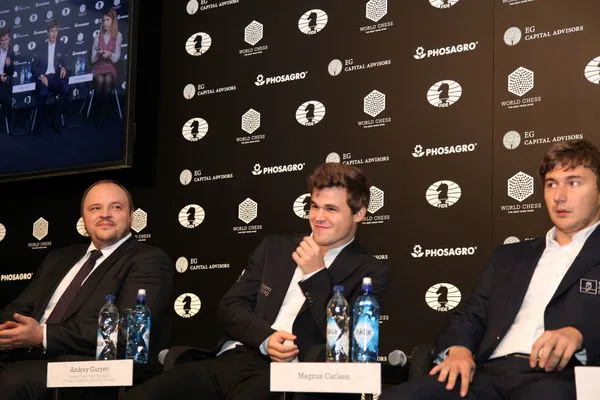

Match results and game references.
Guess the Move tournaments