Javokhir Sindarov: Rise of Uzbekistan’s Chess Star
Javokhir Sindarov emerged as one of the brightest young talents in modern chess after defeating elite grandmasters at an unusually young age. This article explores Sindarov’s rise from child prodigy to international star, his most important tournament performances, and the fearless attacking style that made him one of the leading players of the new generation.
Javokhir Sindarov: Rise of Uzbekistan’s Chess Star
By Elena Kovarik
Javokhir Sindarov became internationally known long before most chess players finish school. Fearless, aggressive, and remarkably composed against elite opposition, Sindarov emerged as one of the leading talents of the new chess generation and helped establish Uzbekistan as one of the fastest-rising powers in world chess.
His rise attracted attention not only because of his results, but because of how young he was when he achieved them. Sindarov earned the grandmaster title at age 12, becoming one of the youngest grandmasters in chess history. Soon afterward, he began defeating world-class players in major international events, proving that he was far more than a junior prodigy.
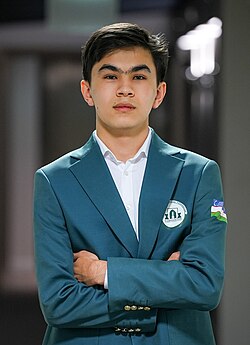
For many chess fans, Sindarov’s games became must-watch encounters because they combined modern opening preparation with uncompromising attacking ambition. Even against experienced grandmasters, he often played with the confidence of a veteran.
A Chess Prodigy From Uzbekistan
Born in 2005 in Uzbekistan, Sindarov grew up during an important period for chess in Central Asia. Uzbekistan had a strong chess tradition dating back to Soviet times, but the country’s global reputation expanded dramatically in the 2020s with the emergence of a powerful young generation.
Sindarov quickly became one of its central figures.
From an early age, he showed exceptional tactical awareness and an instinct for dynamic positions. While many young talents rely purely on tactical complications, Sindarov also demonstrated advanced positional understanding and strong practical judgment in complex middlegames.
His rapid development brought comparisons to earlier teenage stars who challenged elite players without hesitation.
Defeating Magnus Carlsen
One of the moments that introduced Sindarov to a wider global audience came when he defeated Magnus Carlsen in online rapid play while still a teenager.
Victories over Carlsen always attract attention, but what impressed observers most was Sindarov’s confidence. He did not appear intimidated by the world champion’s reputation or experience. Instead, he played actively, accepted complications, and handled the pressure calmly.
For young players, defeating Carlsen in any serious format is a major achievement. For a teenager still developing his career, it immediately elevated Sindarov’s international profile.
The game also reflected a broader trend in modern chess: the new generation was arriving earlier, armed with powerful engine preparation, online experience, and enormous competitive confidence.
The New Generation of Fearless Chess
Sindarov belongs to a remarkable era of young grandmasters that includes players such as Gukesh Dommaraju, R Praggnanandhaa, and Alireza Firouzja.
Unlike earlier generations, these players grew up entirely in the computer era. They learned from engines, online tournaments, and constant access to elite games. As a result, many developed unusually sharp tactical instincts and deep opening knowledge at very young ages.
Sindarov’s games reflect that environment perfectly. He is comfortable in complicated positions where initiative and activity matter more than long-term structural caution. His style often features:
rapid development, energetic piece coordination, tactical pressure, and willingness to accept dynamic imbalance.
That approach made him especially dangerous in faster time controls, where confidence and momentum can become decisive.
Uzbekistan’s Historic Chess Rise
Sindarov’s success also coincided with one of the most important moments in Uzbek chess history.
In 2022, Uzbekistan stunned the chess world by winning the Chess Olympiad 2022 in Chennai. The young Uzbek team defeated far more experienced nations and announced itself as a new force in international chess.
Sindarov played a key role in that success alongside teammates such as Nodirbek Abdusattorov.
The victory carried enormous significance because it broke the traditional dominance of countries such as Russia, the United States, and China. It also demonstrated how rapidly elite chess talent was expanding beyond its historic centers.
For Uzbekistan, the Olympiad triumph became a national sporting achievement. For the chess world, it marked the arrival of a fearless young generation unafraid of established hierarchies.
A Style Built for Modern Chess
Every era tends to produce players who reflect the rhythm of their time.
Classical Soviet champions were often associated with long strategic battles and deep positional planning. The computer era accelerated preparation, increased tactical sharpness, and rewarded flexibility across multiple formats.
Sindarov’s style fits perfectly into that modern environment.
He is comfortable switching between attack and defense quickly, and many of his strongest games involve maintaining pressure in unstable positions where both players must calculate accurately. His willingness to play actively often forces opponents into difficult defensive decisions early in the game.
At the same time, his results show that modern elite chess is no longer dominated purely by experience. Young grandmasters now reach world-class level far earlier than previous generations.
One of the Youngest Grandmasters Ever
Age remains one of the defining parts of Sindarov’s story.
Becoming a grandmaster at 12 placed him among the youngest players ever to achieve the title. That accomplishment alone would have made him notable, but Sindarov quickly proved he could compete successfully against established elite professionals as well.
In earlier eras, talented juniors often needed many years before seriously challenging top grandmasters. Modern players like Sindarov have shortened that timeline dramatically.
The combination of elite coaching, engine preparation, and constant online competition has created a generation capable of reaching extraordinary strength before adulthood.
Still, talent alone is never enough. Sindarov’s rise also required consistency under pressure, resilience in major tournaments, and the ability to perform against world-class opposition repeatedly.
The Future of Sindarov’s Career
For young chess stars, early success creates both opportunity and expectation.
Many teenage prodigies attract attention briefly before struggling to remain at the top level. Others transform early brilliance into long careers competing for world championship cycles and elite tournament victories.
Sindarov’s career is still developing, but he has already established himself as one of the most important players of his generation. His games, especially his attacking victories against elite opposition, continue to attract fans who enjoy ambitious and energetic chess.
More importantly, his rise represents something larger than one individual player. Alongside other young stars from India, Uzbekistan, and beyond, Sindarov is part of a global shift in chess power and culture.
The traditional image of elite chess dominated by older veterans from a handful of countries is fading. In its place is a younger, faster, and far more international generation.
Javokhir Sindarov stands near the center of that transformation.
From Prodigy to World Championship Challenger
In 2026, Javokhir Sindarov achieved the biggest result of his career by winning the Candidates Tournament 2026 in dominant fashion. At just 20 years old, Sindarov finished ahead of elite players including Fabiano Caruana, Hikaru Nakamura, and Anish Giri, securing the right to challenge reigning champion Gukesh Dommaraju for the World Chess Championship later this year.
Chess Game
[Event "World Championship Candidates"]
[Site "Pegeia CYP"]
[Date "2026.04.03"]
[EventDate "2026.03.29"]
[Round "5.1"]
[White "Nakamura, Hikaru"]
[Black "Sindarov, Javokhir"]
[Result "0-1"]
[WhiteElo "2810"]
[WhiteTitle "GM"]
[WhiteFideId "2016192"]
[BlackElo "2745"]
[BlackTitle "GM"]
[BlackFideId "14205483"]
[ECO "D31"]
[Opening "Semi-Slav Defense: Marshall Gambit, Main Line"]
[BroadcastName "FIDE Candidates 2026: Open"]
[BroadcastURL "https://lichess.org/broadcast/fide-candidates-2026-open/round-5/liBI9Brw"]
[GameURL "https://lichess.org/broadcast/fide-candidates-2026-open/round-5/liBI9Brw/IDNHChak"]
[Source "Lichess"]

1. d4 d5 2. c4 e6 3. Nc3 c6 4. e4 dxe4 5. Nxe4 Bb4+
6. Bd2 Qxd4 7. Bxb4 Qxe4+ 8. Be2 Na6 9. Bd6 Qxg2 10. Bf3 Qg5
11. Ne2 Ne7 12. Ng3 O-O 13. h4 Qa5+ 14. b4 Nxb4 15. O-O Re8
16. Qd2 c5 17. Rad1 Nf5 18. Nxf5 exf5 19. Qf4 Nc6 20. Kh1 Nd4
21. Rg1 g6 22. Bd5 Be6 23. Bxb7 Ne2 24. Qd2 Qxd2 25. Rxd2 Nxg1
26. Bxa8 Rxa8 27. Kxg1 Rd8 28. Bf4 Rxd2 29. Bxd2 Bxc4 30. Be3 Bxa2
31. Bxc5 a5 32. f4 f6 33. Kf2 Kf7 34. Ba3 Ke6 35. Bf8 a4
36. Ke3 Kf7 37. Bb4 h6 38. Kf2 g5 39. Kg3 Bd5 40. Ba3 Be4
41. Bc1 gxh4+ 0-1
The victory confirmed Sindarov’s place among the elite of modern chess and marked another major milestone in the rise of the younger generation. His Candidates performance was especially impressive because he remained undefeated throughout the tournament and clinched victory with a round to spare.
The upcoming World Championship match against Gukesh will also be historically unusual. Both players are barely out of their teenage years, making it one of the youngest title matches ever contested. For many observers, the match symbolizes a changing era in world chess, where a new generation has fully arrived at the top of the game.
You can play through Sindarov's games with Guess The Move